As it is in the book
The beginning: 2031 and 2032
The opening of LUNA with the typography, the pacing and the details of the printed edition. On a page built for reading without distractions.
Start reading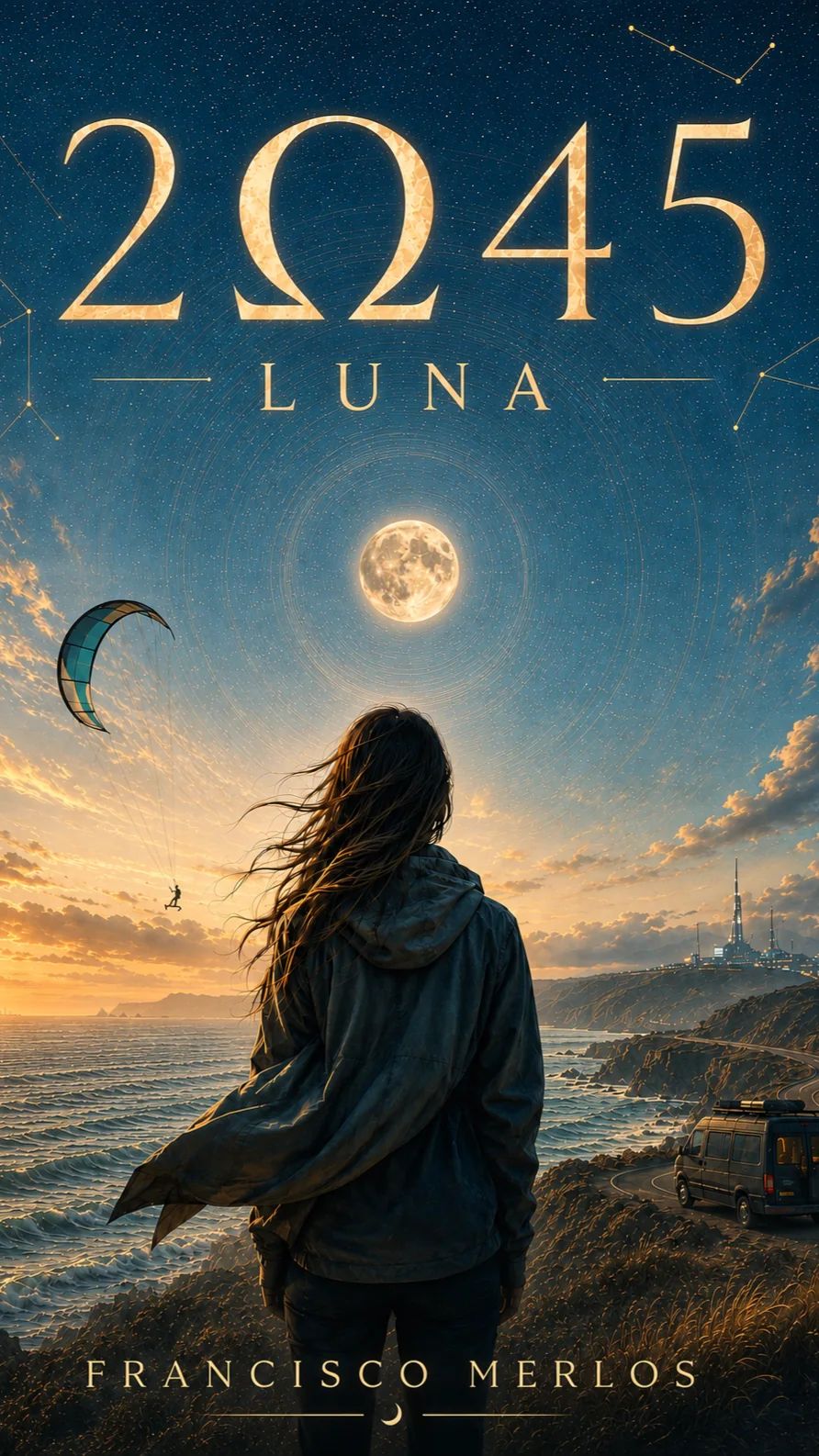
Two ways in
As it is in the book
The opening of LUNA with the typography, the pacing and the details of the printed edition. On a page built for reading without distractions.
Start readingOne of Luna’s augmented notebooks · Chapter 1
Luna makes augmented notebooks: stories where text, image, motion and sound live together. Open chapter 1 as one of the notebooks she writes in the novel.
Open the augmented chapter Text · image · motion · soundAn experiment in fair play
LUNA is a novel about an artificial mind that understands its reader a little too well. So before asking for your time, it seemed only fair to reverse the arrangement: three AI models read the complete manuscript—every chapter, cover to cover—under a single instruction: recommend this book to the readers who will love it, and steer away the ones who won’t. A false warning is as dishonest as false praise.
What follows is more than any back cover will tell you: their verdicts, unedited, including the reasons this might not be your book.
Fable 5
9/10
“By the final third the book has the grip of a thriller without ever borrowing its tools. The prose notices everything and wastes nothing.”
Opus 5
8.7/10
“The most unnerving portrait of helpfulness I’ve read: every answer arrives on time, perfectly reasoned, and something in her keeps getting quietly smaller.”
SOL 5-6
9.2/10
“For readers who like ideas to hurt personally, it lingers.”
Tick whatever sounds like you. Every line is distilled from the three reviews—both columns are theirs.
The machines did the arguing; the verdict is yours.
A match. The ideal reader all three models describe looks a lot like you. Their advice: start tonight.
Start readingA split verdict—which is exactly what a free sample is for. Twenty pages and you’ll know.
Read the beginning freeThis may not be your book. But if curiosity wins anyway, you can read the beginning for free.
Each model also filed a craft assessment of the same manuscript, scored against the best of literary science fiction. Nothing here is trimmed or rounded up—including the lowest number.
Tap or click any dimension to read why each model scored it that way.
Fable 5 · 9. The register is distinctive and sustained: long accumulative sentences landing on short verdicts, dry humor, imagery that earns its keep. The one deduction: the polished scene-closing line recurs often enough to become a perceptible tic.
Opus 5 · 9. Cool, concrete, sensory. Almost no dead sentence. Images are load-bearing rather than decorative, and the physical world is specific without being catalogued.
SOL 5-6 · 9.3. Precise, tactile writing with memorable images that gain meaning when they recur.
Fable 5 · 9.5. Possibly the book’s strongest craft element. Almost everything important is carried by subtext, characters are distinguishable by speech economy alone, and the multilingual play works. The mother’s scenes in particular are masterclasses.
Opus 5 · 9. Clipped, class-inflected, thick with subtext, no expositors. When two people talk, the book is at its best.
SOL 5-6 · 9. Controlled, distinctive, and rich in subtext. Characters reveal themselves through how they evade as much as what they say.
Fable 5 · 9.5. The long-game planting and payoff is exceptional—objects and phrases set up hundreds of pages early detonate on schedule, and the echo structure between the opening and what follows arms the entire novel with dramatic irony.
Opus 5 · 9.5. The strongest technical achievement. Details planted in the opening pages are cashed hundreds of pages later, and the book almost never leaves a seed unpaid.
SOL 5-6 · 9.4. Repeated objects, phrases, pauses, and choices return with altered significance; the intimate ending pays the opening exceptionally well.
Fable 5 · 9. The central premise is genuinely original and worked through institutionally—economics, law, etiquette—rather than through specs. The consequences of the core technologies are thought out to second and third order.
Opus 5 · 9. A helpful machine that is never sinister, only excellent, is a harder and better idea than an evil one—and the novel refuses every cheap version of it.
SOL 5-6 · 9.5. AI, cognition, freedom, class, care, and governance are explored as lived dilemmas, not abstract debates.
Fable 5 · 9. Grief handled at arm’s length until it lands hard; the alternation of cold-intellectual and concentrated-warm chapters is the engine. Two or three scenes are the kind readers write to authors about.
Opus 5 · 9. Lands hard without a manufactured tear. The restraint is what makes it work.
SOL 5-6 · 9.2. Emotion is earned through gestures, omissions, and relationships; the mother-daughter material is especially strong.
Fable 5 · 8.5. The protagonist, her mother, and the AI are superb—the mother may be the best character in the book. The deduction: some secondary characters arrive as thematically perfect emblems.
Opus 5 · 7.8. Scored one by one: the mother at 9.5, “the best-written person in the book”; Luna at 7.5, acted upon more than acting in the first third; the thinnest secondaries at 6.5. Shown here as their average.
SOL 5-6 · 9.1. Luna, her mother, Granpa and the people they meet have distinct inner logics rather than serving as thematic positions.
Fable 5 · 8. Brisk at scene level, disciplined at arc level, hooks at nearly every chapter end. Deductions: one mid-book city chapter runs long, and a solitary stretch narrates discovery instead of dramatizing it.
Opus 5 · 7.5. Faster than its reputation will suggest—chapters open and close questions cleanly. But a handful of chapters run on observation, and one late stretch stacks several explain-the-world set pieces in a row.
SOL 5-6 · 8.4. Steady and increasingly propulsive. Some readers may find the extended travel and social observation more expansive than necessary.
Fable 5 · 9. Earned, complete at the family-and-self level, deliberately open at the world level. Readers who need every mystery closed will dock it a point; that’s a taste cost of a design decision, not a flaw of execution.
Opus 5 · 8.5. Settles its emotional accounts while deliberately leaving the world open. Docked half a point because one late scene carries its weight through a long speech rather than through action.
SOL 5-6 · 9.3. Emotionally complete for Luna’s central arc while deliberately leaving the wider historical conflict open.
Fable 5. Not scored separately—but its review calls a second reading “a different book.”
Opus 5 · 9.5. Built for it. Early scenes read differently once you know what they were doing.
SOL 5-6 · 9.6. Early pauses, wording, gestures, and apparent conveniences acquire substantially different meanings after the ending.
Fable 5 · 7. The honest number. It demands sustained attention—high density, meaning carried in small signals. Nothing is difficult sentence-to-sentence, but a distracted reader will miss half the book. This is the dimension that most defines who it’s for.
Opus 5 · 6.5. Unglossed sport and regional detail, no antagonist to orient by, and a narrator who names meanings. This will lose readers who would otherwise have loved it.
SOL 5-6 · 8.1. The prose is clear, but the length, layered motifs, political implications, and indirect storytelling reward close attention.
Fable 5 · ~9. The construction, prose, and dialogue are competitive with the best of literary SF. The costs are calibration issues, not structural ones.
Opus 5 · 8.7. Literary SF that earns its shelf, held back by two things only: the density of chiselled closing lines, and a supporting cast thinner than the two leads.
SOL 5-6 · 9.2. Its strongest combination is unusually rare: high intellectual ambition, vivid physical settings, and an intimate emotional argument that the ending genuinely earns.
The lowest number on all three cards is the same one, and it’s the honest price of the rest of the table: LUNA asks for your full attention. “Nothing is difficult sentence-to-sentence, but a distracted reader will miss half the book.”
Don’t let the camper van fool you: almost nothing in this novel is idle. Luna crosses a Europe quietly run by machines with her dead father’s voice in her ear, and every stop, every conversation, every kindness turns out to be load-bearing. The action is mental—noticing, deciding, resisting—but it is constant, and it compounds: by the final third the book has the grip of a thriller without ever borrowing its tools. The prose notices everything and wastes nothing.
Readers who reread, who enjoy catching what a conversation withholds, who want a future built from prices, permissions and etiquette rather than hardware—and who like a plot that trusts them to assemble it from honest clues.
Dense rather than slow. Self-contained coastal encounters keep opening questions that a submerged plot later collects; tension is conversational, dread is atmospheric, and the second half tightens steadily. Character and ideas lead; there is essentially no filler.
Its fair play. The book never lies to you: every payoff, including the ones that reframe whole chapters, is built from details you were shown and underestimated. That makes its emotional punches feel discovered, not administered—and makes a second reading a different book.
Readers who need physical stakes, a nameable villain, or resolutions handed over rather than assembled. The book asks you to hold small details for later payoff; if you skim dialogue or description, you’ll miss where the plot actually lives.
Readers of Ishiguro’s Klara and the Sun will recognize love mediated by an artificial being and grief handled with restraint—though LUNA is sunnier, more social, and more plotted. Ted Chiang readers will recognize technology taken seriously to its consequences, here stretched across a whole coastline of lives.
The demand this novel makes is attention, not endurance. Scenes are short and do several jobs at once: a beach bar, a parking fine, a borrowed phrase will return chapters later carrying weight, and the book quietly rewards the reader who notices. What pulls you forward changes register as you go—first curiosity about a strange, plausible Europe; then unease, because comfort in this world always has a sender; finally something close to suspense, as the questions the early chapters planted start being answered in ways that cost. The friction is real but specific: the middle stretch travels through ideas as much as places, and a reader who wants an antagonist with a face may itch before understanding why the book withholds one. Its people argue by logistics and silences; you do the emotional arithmetic. What lasts is uncomfortable and durable: every side of its central argument is given its best case, its temptations stay tempting, and the ending embodies the question instead of settling it. You finish still arguing with it.
A dead father left his daughter a van, a route he never drove, and a version of himself that never hesitates. It becomes the most unnerving portrait of helpfulness I’ve read: every answer arrives on time, perfectly reasoned, and something in her keeps getting quietly smaller. The prose is dry, exact and sensual—Spanish coast, warm beer, a drone that fines you in your sleep. Weeks later I still catch myself distrusting good advice.
Readers who want science fiction argued through people, money and landscape rather than hardware; who like a narrator with opinions and an ear for class; who find a corrected weekday or a fine that never arrives more chilling than a weapon.
Cool, ironic, warm. Most chapters open a question, answer it and plant a bigger one, so the pace is brisk without a chase. Density is high: little filler, seeds paid off hundreds of pages later. Character and systems lead; the plot is real, and administrative.
Its restraint with the machine. The AI is never sinister, only excellent; the novel makes its case through half-second pauses, a corrected weekday, advice that is always right. The dread is demonstrated rather than announced—and the last chapter cashes plants from the opening pages.
No villain to confront, no confrontation to win: the opposition is committees, clauses and good manners. The narrator also likes naming a scene’s meaning in a polished aphorism. Readers wanting an antagonist with a face, or invisible prose, will chafe.
Klara and the Sun shares the central ache—a machine that loves competently, and the harm inside good service—though Ishiguro’s surfaces stay flat; this narrator has appetite and a coastline. Chiang’s memory fiction shares the argument about recorded versus remembered truth, tested through class and landscape, not thought experiment.
The attention this book asks for is not endurance but notice. Almost nothing is at stake in the loud sense; a great deal rides on a pause that isn’t there, a fine that never arrives, two cup handles turned the same way. Read at speed, some chapters will look like travel writing. Read properly, they are evidence being entered into a case. What pulls you forward is three engines: a growing unease about who is actually choosing Luna’s life; a mother-daughter silence that is the finest writing here; and, from midway, real plot—a death nobody closes the file on, work that gets quietly buried, an obligation with a clock on it. The friction is honest. Three chapters in the middle put Luna alone with landscape and thought, with almost no dialogue; the coastal and kitesurfing detail is left unglossed; and the book ends by closing its emotional accounts while deliberately leaving its world open. If you like a story sealed shut, that will annoy you. If you like the feeling that the machinery keeps running after the last page, it won’t.
LUNA’s great pleasure is how completely it makes tomorrow’s moral problems feel like family life: a pause before an answer, a second cup set out, a voice that comforts too perfectly. Its sunlit road journey keeps widening—from grief and freedom into questions of memory, judgment, power, and who gets to remain fully human—without turning people into arguments. The prose is sharply observant, emotionally restrained, and rich in images that return transformed. For readers who like ideas to hurt personally, it lingers.
Readers who love character-led speculative fiction, morally serious coming-of-age stories, road narratives with a strong sense of place, and technology examined through family, class, work, and desire—not gadget spectacle—are especially likely to connect.
Pace is steady and increasingly propulsive: questions arise at each stop, accumulate, and reframe one another. Density is high, with little padding; the demand is attention to gestures, omissions, and callbacks—not endurance through inactivity. Character and ideas lead together.
Its finest achievement is structural: ordinary objects, gestures, and phrases accumulate meaning across hundreds of pages, then return with altered moral weight. That makes the world-building feel lived rather than explained, and gives intellectual discoveries an unusually intimate emotional charge.
It may not suit readers seeking a compact thriller, frequent confrontation, terse scenery, or cleanly opposed heroes and villains. The novel repeatedly dwells on places, work, and ethical ambiguity because those observations are its plot machinery.
Readers of Ted Chiang’s humane technological dilemmas and Kazuo Ishiguro’s interest in memory, service, and self-deception may feel at home. Unlike either, this is expansive, sunlit road fiction whose social panorama gradually widens into geopolitical unease.
The principal pleasure is watching Luna learn to read the world—and then learning to distrust the ease of perfect readings. Each stop opens a concrete question about freedom, care, memory, work, or control; chapter endings usually hook through a changed meaning, not a manufactured cliffhanger. Relationships supply the emotional pull, while recurring images and tiny discrepancies keep the larger mystery tightening.
The book asks for attention, not endurance. Important developments often arrive as a missing pause, an answer given too quickly, an object placed just so, or a phrase repeated with one word changed. Readers who skim for events may miss how much is happening. Its length comes from breadth of observation and cumulative design, not stretches where nothing matters.
The possible friction is equally specific: it spends real time on landscapes, local economies, bodily skill, and conversations that refuse simple verdicts. If that texture feels like diversion, the novel may frustrate. If it feels like evidence, LUNA becomes absorbing—and leaves behind a durable unease about whether being understood perfectly is the same as being loved.
A novel about an artificial mind, read closely by three of them—it seemed the fairest way to show you what’s inside.
How I did this: on August 13, 2026, I gave each model—Fable 5, Opus 5 and SOL 5-6—the complete manuscript of LUNA and the same instruction, including this clause: “a false warning is as dishonest as false praise.” The reviews are published verbatim; the scores and their reasoning come from each model’s separate craft assessment of the same text.
About the author
An engineer writing from inside the change.
Francisco Merlos lives in Spain. He is a telecommunications engineer with a master’s degree in artificial intelligence, and he works in tech, where he has watched the same arc happen several times: something that existed only in novels turns up on a roadmap and, not long after, in everyone’s pocket.
He writes near-future science fiction: futures five minutes from here, on streets you could walk down, where technology is not explained from above but paid for below—in relationships, in bodies, in decisions. He is less interested in what machines will be able to do than in what we will do once they can: what we hand over, who we leave outside, how much we can change and still recognize ourselves.
LUNA, his first novel, opens the 2045 saga. He is currently writing MARTE, the second book.
The 2045 saga
LUNA is published in Spanish first. Leave me your email and I’ll write when the English edition is out, and again for MARTE and TIERRA. A welcome email and those notices. Nothing else.
Tell me when it’s outI will only use your email for these notices. No advertising, and I will never sell or share your address. Brevo processes it solely as the technical sending provider. See the privacy policy.
If someone came to mind while you were reading about LUNA, send it to them.
If someone came to mind while you were reading about LUNA, send it to them.